Why friendship break-ups can hurt more than romantic break-ups
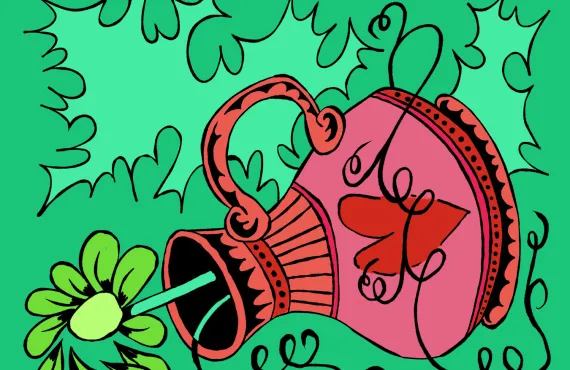
By Jessie Davidson, first published in Massive Magazine. Artwork by Olive Bartlett
You go to send them a meme and then remember they won’t reply. You reach for your phone to call them after a breakup and then remember you can’t. You go to ask them for a coffee and then remember they’re gone.
Friendship breakups can be just as painful as romantic breakups, and yet they’re far less understood. Often, this lack of societal understanding leaves you even more isolated than you already feel—particularly now that you’ve lost your person.
Romantic breakups often come with structure. There are timelines, rituals, movies, songs, and a million proven ways to move on.
But friendship breakups rarely offer that.
There’s no breakup talk, no playlist, no mourning period, and no societal script. Whether it ended through a slow fade, a sudden shift, a fight, or a freeze—it leaves a lot of unanswered questions.
You rehearse things you should have said. You miss how they saw you and your thoughts. You miss the person you became with them. You feel like you’re supposed to act like nothing happened even when your brain is replaying every little detail, memory and moment.
These thoughts loop over and over again until you’re left asking: what went wrong?
Neuroscientist and author, Dr. Caroline Leaf, explains on her podcast, The Dr. Leaf Show, that friendship grief carries a unique kind of disorientation.
“Friendships are emotional ecosystems,” she says. “You share rituals, language, timing. You built a whole rhythm around each other. And when that collapses, your conscious mind living through your nervous system doesn’t just feel sad. It feels lost.
This loss feels different depending on how the friendship ended. If you were ghosted, you’re left looping through confusion. If the friendship simply faded, you feel like you should have tried harder to hang on. Whereas friendship fallouts leave you replaying the arguments in your head long after the fact.
But Leaf says, “Your brain doesn’t care what culture says. It only knows the bond is gone.”
“Friendship grief is not just sadness, it’s cognitive reassembly. Your brain is being forced to rebuild a version of you without the person who helped shape it.”
Psycho-neurobiology codes friendship as a survival mechanism. When you form a close bond with someone, your brain weaves that person into multiple operating systems.
“Memory, self-concept, prediction, even in a dialogue, they [the friend] are quite literally inside your head.”
Leaf says that in deep friendships, you begin to internalise each other’s voice. You can predict how they’d react, laugh, text, and respond. As a result, this voice becomes a part of your own internal narrative.
But when this friendship ends, the absence disrupts more than communication. It also “collapses the structure of your psycho-neurobiology”.
“Your thoughts may feel less organised, your emotional processing may feel clumsier, you’ve lost a co-narrator.”
Our minds constantly use previous experiences to predict how social interactions will unfold. With trusted friends, this prediction become second nature and goes quiet because you feel like you don’t have to anticipate any threats. But when a friend disappears and breaks this easy prediction system, your brain has to restructure.
Leaf says, “You experience a spike in uncertainty around all relationships. You may feel extra sensitive to rejection, more cautious in conversations, or overly vigilant with new people.”
Suddenly, your brain feels abandoned and unanchored—often without any closure.
This lack of closure leaves your brain trying to answer questions you may never get the answers to: Was it something I did? Do they even understand how they hurt me? If we were so close, why have they left me?
Leaf explains that these are “unmet prediction loops trying to complete themselves”.
“They [the thoughts] won't resolve with logic alone, because your mind doesn't grieve through answers, it grieves through reconceptualisation. Through telling a new story that integrates the pain without erasing the meaning.”
There’s this idea that healing can only occur once we’ve found closure through a final conversation or mutual understanding. But most friendships end without these things happening.
Rather than waiting for an apology, explanation or reconciliation before moving forward, you can accept that you may never have all the answers. And moving on doesn’t mean forgetting the good memories or pretending the friendship didn’t matter. It means changing what those memories mean to you.
Closure is about choosing meaning over mystery. And when a friendship ends, you’re not just grieving the person, you’re also figuring out who you are without them.
“That choice between mystery and meaning is what gives your mind back its authority and peace,” Leaf says. “As long as you stay in mystery ... your sense of safety stays tied to someone else’s return.”
“When you shift towards meaning ... You step out of waiting and into remembering and that remembering becomes the soil for growth.”
But how do you move past the painful feeling that a friend who once knew everything about you now feels like a stranger who still lives in your head?
you’ve lost a co-narrator
Because friendship grief isn’t openly validated, you expect to just move on. So, you shrink your grief. You use words like ‘drifted’ and ‘grew apart’, even when it feels like someone has taken a jackhammer to your heart.
After a particularly hard friendship breakup of my own, I found myself lost within a cycle of internal blame. I shut many people out, because I worried that once they got to know all of me, they’d also leave me behind.
But this only brought me more grief.
It was only until I started talking about it with a close support system that I could begin to piece myself back together.
It’s unsurprising to find that ways to heal after a friendship breakup are very similar to methods you follow after a romantic breakup. But because friendship breakups have less scaffolding of social support and established norms, these rituals are harder to identify.
But emotional pain should never require external permission.
You have to let yourself grieve when you lose a friend. You lost someone who mattered, someone who built a part of your identity and role, and someone who made you feel like you belonged.
Validate this loss and understand that the emotions behind it are complicated. But just because they’re complex, resist the urge to understand everything. This can be painful, but also an important part of healing.
You need to talk about it. Treat it like a romantic breakup. Find a support circle who will witness your grief without dismissing it and who will give you the time to heal.
In saying that, you also need to give yourself the time to heal.
The end of a friendship is a real loss. If you rush past that grief, it’ll become harder for you to eventually be open again. Leaf explains that when your mind is grieving because you lost something real, and then you deny that reality, your nervous system ends up carrying this grief alone.
“Just because the world doesn't name it, doesn't mean it's not real.”
Ultimately, I think one of the most important things to remember is that you are allowed to hold onto the goodness that the friendship brought you without ignoring the harm.
You can love who you were in that friendship without needing it to resume.
You can feel hurt but still understand why it had to end.
Tagged
You may also like
-
 Read
Cling, withdraw, or stay calm? How your attachment style shapes the way you handle jealousy
Jealousy, Advice (+2)